
Glades County Court Records After a Jail Arrest
An arrest in Glades County does not create a court case by itself. It creates a booking record at the jail. The court record begins later, when a prosecutor reviews the arrest and decides what to file. In Glades County that prosecutor is the Office of the State Attorney, Twentieth Judicial Circuit, led by State Attorney Amira D. Fox. Once the state files a charge, the Glades County Clerk of the Circuit Court and Comptroller opens a case file. From that point on, the charges, hearings, and rulings live in the court record, not on the jail roster.
It helps to keep the two sides apart. The arrest and booking side shows custody, the booking date, and the charges an officer listed at intake. You can check that on the jail inmate records page for the roster and custody status, and on the jail mugshots page for booking photos. The court side shows what the prosecutor actually filed and how each charge moves through the system. Booking charges and filed charges are not always the same. The court records are the place to confirm which charges the state is really pursuing after an arrest.
The State Attorney handles the prosecution end. The Clerk handles the filing and the public record. Knowing which office owns which step saves time when you start a search. The State Attorney decides and argues the charges. The Clerk stores the case file and runs the public court-record search.
How to Find Glades County Court Records After an Arrest
The Glades County Clerk is the custodian of all court records. The Clerk's felony division page carries a "Click Here to Search Court Records" link that opens the Civitek Florida public court-record search. That portal is the official route to charges, case numbers, and charge status after an arrest. The jail roster still holds the arrest and booking detail, but the filed charges and their outcomes show up in the court case file. The Clerk's office can be reached at (863) 946-6010 for help with a case.
The Clerk publishes its court-record search through Civitek. The steps below walk the basic case lookup.
- Open the Civitek Florida court-record search linked from the Glades Clerk felony page.
- Search by the defendant's name or, if you have it, the case number.
- Open the matching case and read the full list of charges the prosecutor filed.
- Check each charge for its statute code, its level, and its current status.
The Clerk's own public-record notice reminds searchers to try every spelling variation of a name, since one typo can hide a case. A case is filed under the spelling on record, so test shortened and alternate spellings before deciding a case does not exist. For a statewide criminal-history check rather than a single county case, the Florida Department of Law Enforcement runs an official record check, though that is a history report and not a live case search.
The portal itself is the front door to every filed case in the county. The image below opens it.
The Glades Clerk routes its public court search through the state vendor, so a case lookup starts there. Open the Civitek Florida court records search to begin.
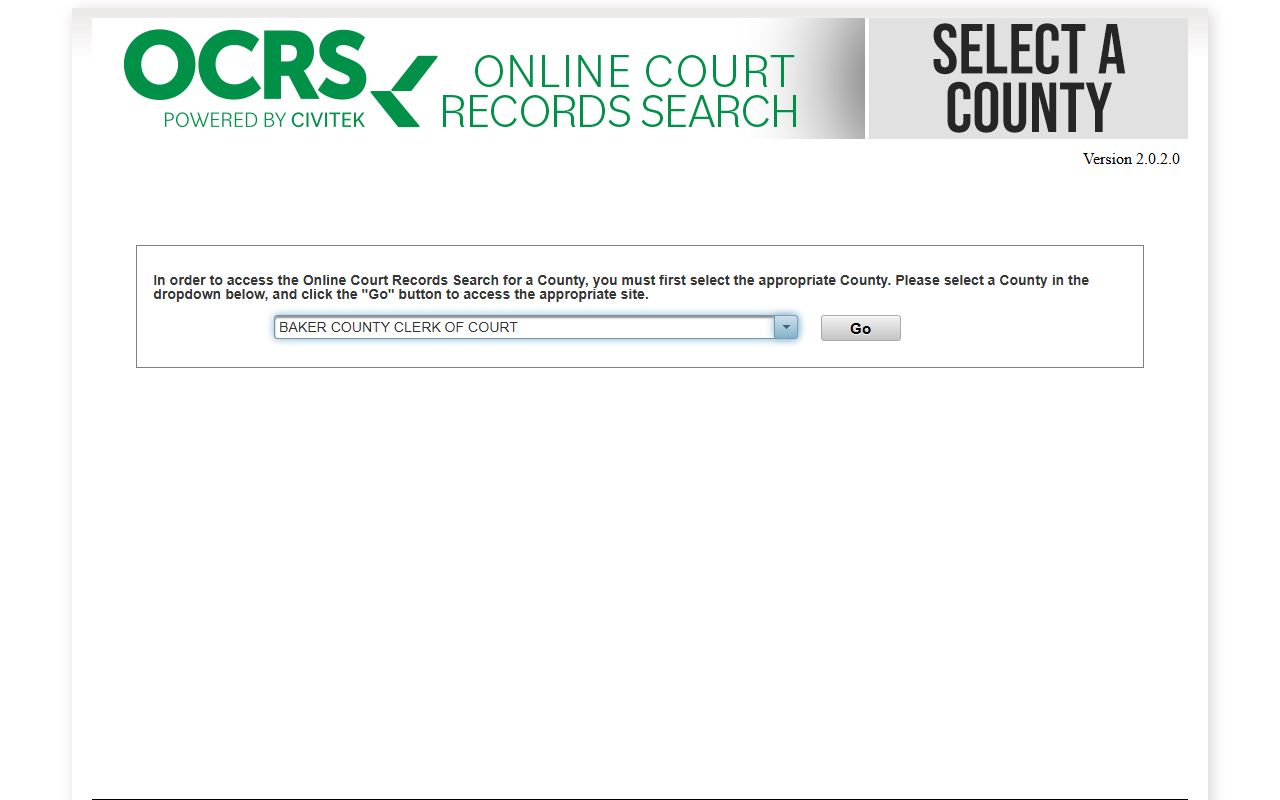
From that search you reach the filed charges, the case number, and the charge status, which is the court record that opens after an arrest. The Glades Clerk felony court page lists the failure-to-appear warning, the sealing and expungement pointer, and the Circuit Criminal Division mailing address.
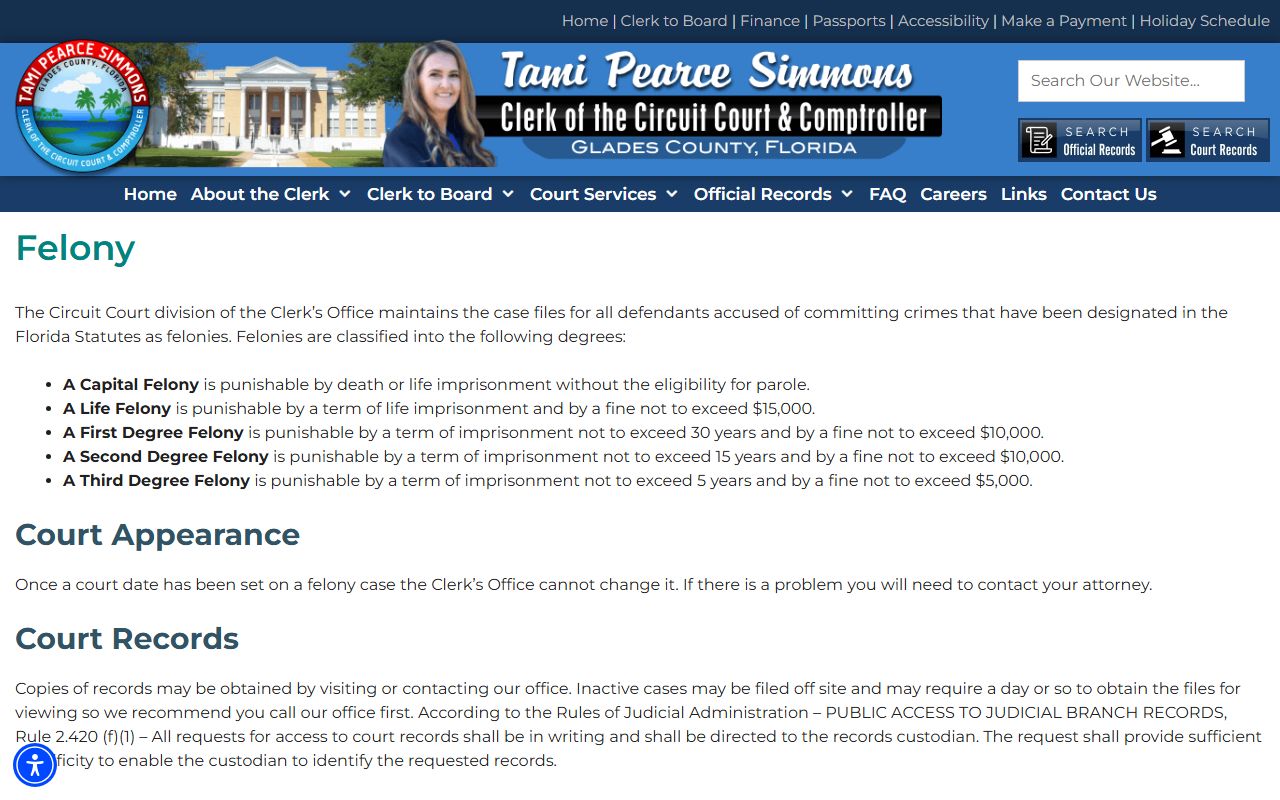
That page ties the court-record search to the rest of the case process after an arrest, from the search link to the fee schedule and the written-request rule.
Written Court Record Requests and Copy Fees
Court records in Florida follow a judicial-branch access rule that is separate from the sheriff's public-record process. The Glades Clerk cites Rule 2.420(f)(1), which says a request for access to court records must be in writing, directed to the records custodian, and specific enough to identify the records you want. A vague request slows everything down. Name the parties, the case number if you have it, and the documents you need.
The Clerk charges set fees for copies and searches. Mailed requests need payment up front and a self-addressed stamped envelope, and the office asks you to call first so it can count the pages.
| Service | Cost |
|---|---|
| Copy of a court record | $1.00 per page |
| Name or case search | $2.00 per search |
| Certified copy | $2.00 per certification |
| Mailed copy request | Payment plus self-addressed stamped envelope; about 7 to 10 working days |
Do not mail cash. Inactive or older cases may be stored off site, so they can take a day or more to pull for viewing. The Clerk recommends calling (863) 946-6010 before you ask for an inactive case so the office can locate the file. The Clerk is at P.O. Box 10, 500 Avenue J, Suite 102, Moore Haven, FL 33471, and the Felony / Circuit Criminal Division takes mailed requests at 500 Avenue J, Suite 500.
Note: court-record requests run through the Clerk, while law-enforcement booking records run through the sheriff, and the two offices follow different rules and timelines.
How Charges Get Filed After an Arrest
The pathway moves in order. Booking happens at the jail right after the arrest. The court charge record begins only when the prosecutor files a formal charging document. That document names the offenses the state will pursue. Florida uses three main types, and the type tells you who decided to bring the charge.
| Complaint | Information | Indictment | |
|---|---|---|---|
| Filed By | Officer / Prosecutor | Prosecutor | Grand Jury |
| Common For | Misdemeanors | Many felonies | Serious felonies |
| Starts | The case | The case | The case |
In Glades County, felony charges such as grand theft move through the Clerk's Felony / Circuit Criminal Division. The State Attorney's office reviews the arrest and decides whether to file, what to file, and at what level. The prosecutor below handles that decision for Glades.
The State Attorney for the Twentieth Circuit serves five counties, including Glades, from a Moore Haven office. See the State Attorney's office for the circuit it covers.
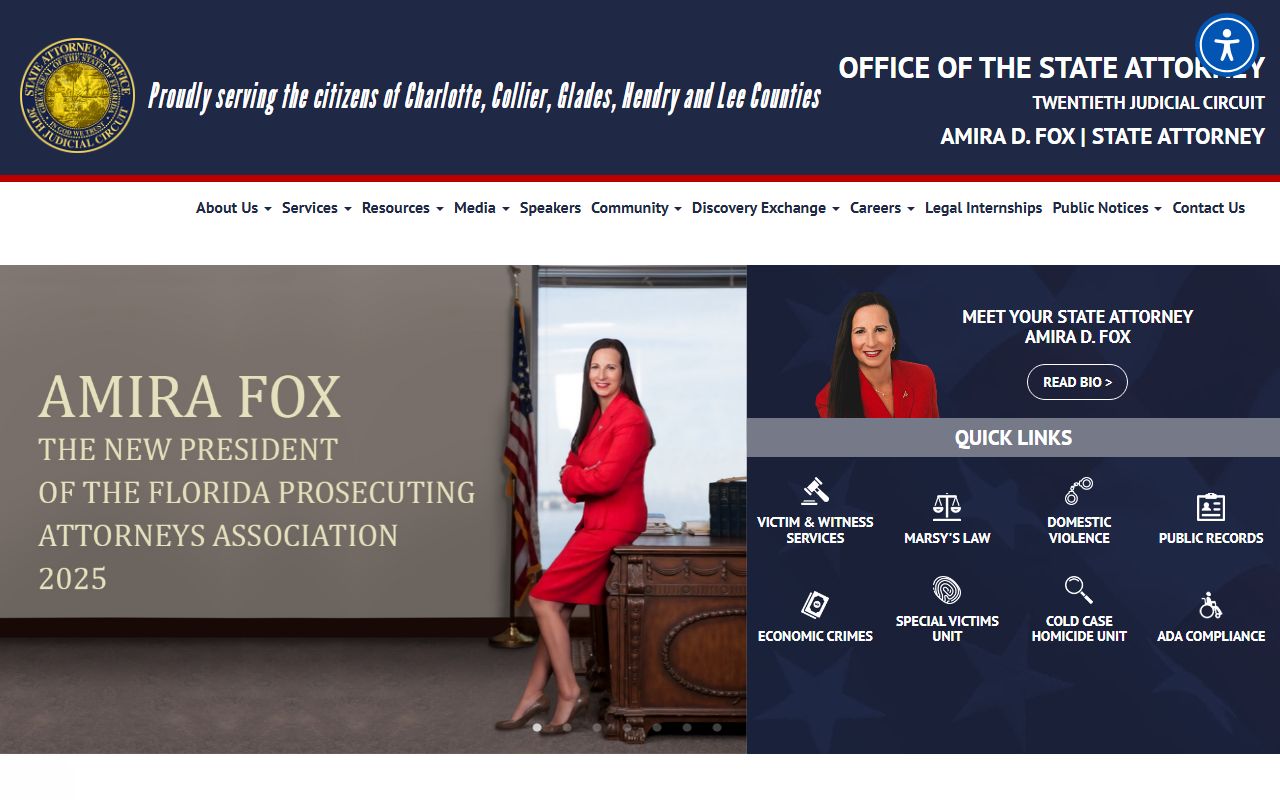
Because the same office covers Charlotte, Collier, Glades, Hendry, and Lee, the prosecutor is a State Attorney by circuit, not a county district attorney. The charging decision after a Glades arrest still runs through this office.
State Attorney Amira D. Fox has a long tie to the county and once led the Hendry and Glades office. Her official bio covers that history.
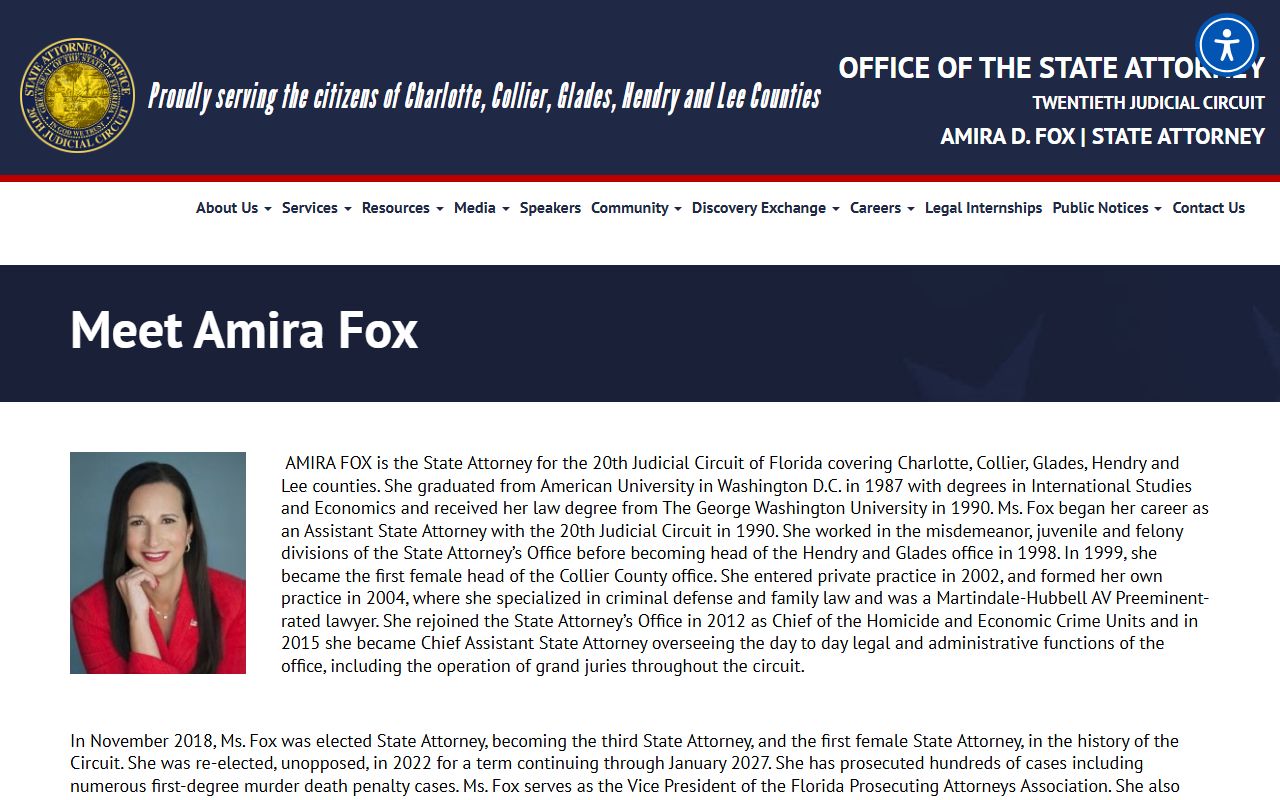
She was elected in 2018 and re-elected unopposed, so the office that files charges after a Glades County arrest has had steady leadership.
Charge Status in the Court Record
Charges are not fixed. As a case moves, the state can amend a charge, reduce it, add a count, or drop it. This is why the charges in the court record can differ from the charges an officer listed at booking. The booking sheet reflects the arrest. The court record reflects what the prosecutor actually filed and pursued. A booking charge is not a conviction, and only a disposition or sentence in the Clerk's file confirms an outcome.
| Status | What It Means |
|---|---|
| Pending | The case or charge is still open and has not been resolved. |
| Amended / Reduced | The charge language or count changed, or the charge was lowered to a less serious offense. |
| Dismissed | The court or the prosecution dropped the charge, ending it. |
| Nolle Prosequi | The prosecutor formally declines to proceed on that charge. |
You may also see "adjudicated guilty," which means a conviction was entered, or "withhold adjudication," where a Florida court holds off on a formal conviction depending on the charge and sentence. Read each charge line on its own. One case can hold several charges at different stages.
Bond and Release After an Arrest
People arrested in Glades County who do not bond out appear before a judge within the first 24 hours of arrest. At that first appearance, the judge tells the person the charges and the bond amount. The hearing can happen in front of the judge in person or by Poly Com video. Bond is what lets a person leave jail while the case goes on. The type of bond sets how that release works.
| Bond Type | How It Works |
|---|---|
| Cash Bond | The full amount is posted directly to meet the court's release condition. |
| Surety Bond | A licensed bail agent posts the bond for a fee and supervises the promise to appear. |
| PR / Own Recognizance | Release on a written promise and conditions, with no money posted, where the judge orders it. |
| No-Bond Hold | Release is not available until the court changes the order or a legal hold is cleared. |
A hold can come from ICE, another county, probation, parole, or a federal authority, and it can keep a person in jail even when a local bond looks available. Confirm whether any hold exists before paying a bond agent. For custody and bond status, call the jail at (863) 946-1600. If a person fails to appear in court, the Clerk warns that a warrant is issued, any bond already posted is forfeited, and the person may then be held without bond.
Court costs are a different matter from jail bond. Fines, fees, and service charges in a filed case are paid to the Clerk, in person by cash, check, money order, or card at 500 Avenue J, Suite 500, or by card over the phone at (863) 946-6010 with a 3.5% card fee. Mailed payments go to the same suite, Attention Collections Division, payable to Glades Clerk of Court, with the case number included, and no cash by mail. Paying court costs does not release someone from jail. That takes a bond, which is a separate payment with a separate purpose.
Note: a court financial obligation and a jail bond are not the same thing, and clearing one does not clear the other.
Warrants That Lead to a Glades County Arrest
A warrant is often what puts a person back in custody after a case is open. No complete official active-warrant database was located for Glades County in the pages reviewed. The sheriff keeps a Most Wanted link under its Law Enforcement menu, but that is a selected list, not a full warrant search. For court-related warrants, the Clerk's felony page is the strongest local source, since it explains the failure-to-appear rule and the bond forfeiture that follows.
Warrants come in a few forms. An arrest warrant is a judge's authorization to take someone into custody. A bench warrant is issued by the court, often for a missed hearing or a violated court order. A search warrant covers a place or item and is not an order to arrest. A fugitive warrant or out-of-county hold means another jurisdiction wants custody. An ICE or federal detainer is not a state warrant, but it can still block release from the county jail.
No single website clears a warrant. To check court status after an arrest, search the case through the Clerk and Civitek route or send a written request to the Clerk. For custody and any hold, call the sheriff at (863) 946-1600. A statewide FDLE criminal-history check can show Florida arrest history, but it is a record report, not a live warrant clearance tool. For a serious charge or a possible no-bond hold, speak with counsel before walking into an office.
Charges vs. Convictions in Court Records
Being arrested and charged is not the same as being convicted. A charge is an accusation that the state must still prove. A conviction is the result, entered after a plea or a verdict. The court record after an arrest can show a charge for months before any outcome is reached, and many charges end without a conviction at all. Read the disposition line, not just the charge line, before you draw a conclusion.
| Charge | Conviction | |
|---|---|---|
| Stage | Accusation | Verdict or plea |
| Burden of Proof | Probable cause | Beyond reasonable doubt |
| Public Record | Yes | Yes |
Both the charge and the conviction sit in the public court file under Florida law. Section 119.0714, Florida Statutes, governs how court files and official records are accessed and exempted, and it is the rule that separates court-case access from sheriff booking records. The court-records statute is why a filed charge stays public even before a case is resolved.
Sealed vs. Expunged Court Records
After a dismissal or an eligible outcome, some people can clear a record. Florida handles this two ways. Sealing hides a record from public view under section 943.059. Expunction goes further and orders the record destroyed under section 943.0585. The Glades Clerk does not decide eligibility on its own. It points people to the Florida Department of Law Enforcement Seal and Expunge process, which is the official starting point.
| Sealed | Expunged | |
|---|---|---|
| Visibility | Hidden from public | Destroyed / treated as never existed |
| Law Enforcement | Limited access | Very limited |
| Eligibility | Set by section 943.059 and FDLE review | Set by section 943.0585 and FDLE review |
Eligibility turns on the charge, the outcome, and a person's prior history, and not every case qualifies. Do not assume a record can be cleared. Read the sealing statute and the expunction statute, then confirm with FDLE, the Clerk, or an attorney. People who cannot afford a lawyer can reach the Public Defender's Office at (863) 946-6029.
Background Check Considerations
People search court records after an arrest for many reasons, and not all of them are casual. A formal background check used for hiring, housing, credit, or insurance falls under the Fair Credit Reporting Act and must be run through a licensed consumer reporting agency that follows that law. A casual look at a public court file through the Clerk is a different thing, and it carries none of the FCRA protections or duties.
Important: The records described here come from public court and jail sources and are not an FCRA-regulated consumer report, so they cannot be used for employment, tenant, credit, or insurance screening.
Restricted Court Records After an Arrest in Glades County
Not every record tied to an arrest is open. Florida's Chapter 119 public-records law favors access, but it carries exemptions, and several of them apply here. Most juvenile records are confidential, and the Clerk's juvenile department keeps them out of the general public file. A charge that has been sealed or expunged is removed from normal public access. A charge dismissed early may show a limited disposition, and active investigative records can be withheld under section 119.071 while a case is still being worked.
Section 119.0714 sets how court files and official records are handled, including what stays open and what is exempt. The line between a sheriff booking record and a court file matters, since each follows its own access path. For a charge that is sealed, confidential, or under investigation, the public portal may show little or nothing, and a written request may be denied. When that happens, the office must tell the requester why. Read Chapter 119 for the full set of public-record rules and the exemptions that shape what a court record after an arrest will show.